International cooperation opens up great opportunities for business: companies are expanding sales markets, building new supply chains, attracting foreign suppliers and contractors. At the same time, the level of risk increases.
Example: A Russian company negotiates with a foreign IT contractor to develop a digital platform. Prices are below the market, terms are minimal, documents look convincing. But after transferring the advance payment, the contractor disappears, and its' registration data turns out to be false. The business loses money and remains without legal protection, since it is difficult and expensive to sue in a foreign jurisdiction.
It is always more difficult to check foreign partners than domestic ones. Each country has its own disclosure requirements, and direct access to registries is often limited.
Today it is impossible to assess a partner only by commercial conditions or a spectacular site. Even a seemingly reliable company can hide debts, legal proceedings, sanctions risks or ultimate beneficiaries. An error in choosing a counterparty leads to direct losses, loss of reputation, legal and compliance risks.
In such conditions, deep verification of foreign companies is an obligatory part of economic security and capital protection.
International trends in counterparties check
The approach to assessing foreign companies has changed. Previously, a basic check was enough: the status of a legal entity and registration data. Today, companies are moving to a comprehensive assessment, in which two main trends are distinguished:
- Increased Transparency. Analyzing only the company itself is not enough. It is important to study the ownership structure, find the ultimate beneficiaries, check affiliates, legal proceedings history and sanctions risks. Signs of fictitious activity, financial stability and business reputation are also checked.
- Automation. Business requires high decision-making speed, so companies are adopting digital tools. They allow to instantly receive information from different jurisdictions and minimize the influence of the human factor.
International practice shows that the main risks when working with foreign counterparties remain:
- cooperation with companies under sanctions
- provision of inaccurate registration data
- hidden change of owners and beneficiaries
- financial instability of partners
- involvement of companies in litigation
- use of fictitious or shell organizations
Approach to foreign counterparties screening.
Proper check of a foreign partner helps to assess its reliability and identify hidden risks even before concluding a deal. To do this, it is necessary to verify the set of data:
- company registration data
- status, types of activities and duration of the company
- ownership structure and ultimate beneficiaries
- sanctions restrictions
- legal proceedings;
- financial statements and signs of insolvency
- business reputation and links with other companies
Different standards of disclosure cause a particular difficulty of international checks. Some countries keep data in closed state registers and provide them only upon official request.
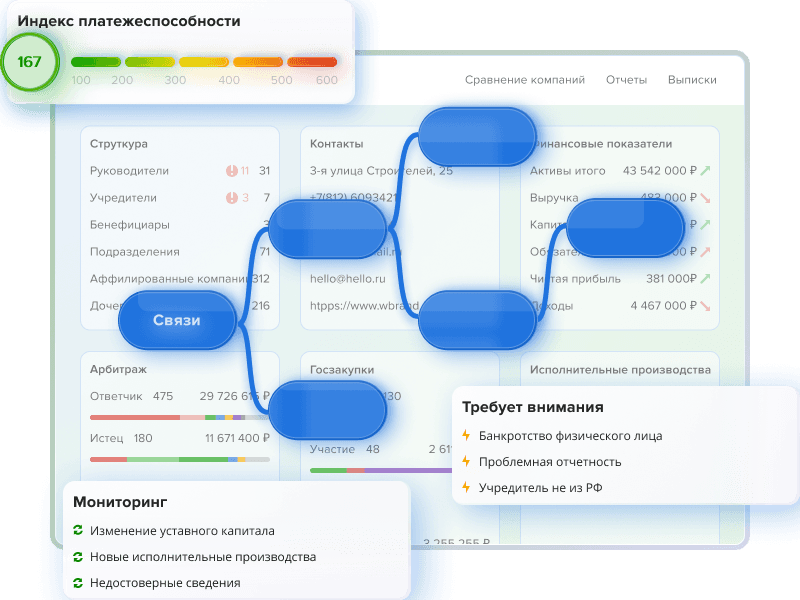
Globas provides direct access to official data from over 220 countries and regions. Credinform experts will help assess the company's solvency, identify shareholders or check registration in an offshore zone.
Online check: instant risk assessment
There are on-line and off-line methods of checking foreign companies. They solve different problems depending on the depth of analysis required.
On-line verification allows to quickly collect basic data: registration information, organization status, sanctions risks, affiliated entities and mass media check. This format is especially in demand at the stage of initial analysis of the counterparty, when it is necessary to promptly assess the potential risks and decide whether to continue negotiations.
Benefits of on-line screening:
- Time saving: collecting information takes no more than a couple of hours
- Automation: the process is easy to build into workflows
- Speed of verification: rapid identification of risks
- Cost reduction: primary analysis is cheaper than in-depth research
In Globas, you can check entities from Europe, America, Africa and the Asia-Pacific region on-line. Get verified and detailed information in just 1–2 hours!
On-line reports contain basic information on companies worldwide.
- company name
- registration data
- contact details
- management
- shareholders
- activity types
- subsidiaries and affiliated companies
- financial statements
- maximum credit
- sanctions
- mass media check
Off-line reports: in-depth analysis and legally relevant information
Open data is not always enough. If it is about large-scale deals, long-term cooperation or increased compliance requirements, an off-line check is required. It involves obtaining official documents, legally significant information and expanded reports from foreign registries and authorized sources prepared by Credinform experts.
This approach allows:
- to confirm the accuracy of the information
- to identify hidden risks
- to receive extended information about the company's activities
- to provide a higher level of legal protection to the business
Off-line reports in Globas comply with international standards and include data on registration, management and shareholders, activities, financial statements (balance sheet, profit and loss statement), as well as the risk assessment of the company: the feasibility of cooperation, the level of credit risk and the recommended credit limit (if there are current financial data).
Additionally, our experts screen for the following data:
- affiliated and subsidiaries in the Russian Federation
- legal proceedings, enforcement proceedings in the Russian Federation
- certificates and declarations of conformity issued in the Russian Federation
- entry into the sanctions lists of Russia, the USA, the EU, Great Britain and other countries
Globas as a risk minimization tool
Due to the growth of international risks and the complication of compliance requirements, businesses need reliable digital solutions. Globas helps to overcome the lack of open data and provides comprehensive verification of foreign partners to increase trust and reduce risks when building international business relations.


Globas
Credit reports on foreign companies
Thanks to a developed network of international partners, Credinform provides information about companies and entrepreneurs in over 220 countries and regions of the world. We find data of any scale: from multinational corporations to local offshore companies. The experts will check the counterparty's solvency, find real owners and confirm the fact of registration. You will receive a ready-made conclusion that will help you make the right decision about cooperation and protect your business from risks.