
Herald

Portfolio Module: Mass Screening and Monitoring of Counterparties in Globas

#
Image: Сгенерировано с помощью ИИ/ Generated with AI
In the counterparties' screening, the trend towards mass analysis of companies is becoming more and more notable. The growth in the number of partners, the complication of regulatory requirements and the increase in the amount of available data form a request for tools that allow assessing risks not pointwise, but immediately across the entire array of counterparties.
Security, compliance and financial control experts are increasingly focused on solutions that allow a large number of companies to be audited in an automated manner and get an overall picture of risks as soon as possible.
Consistent and spot check of companies remains a common method, however, with an increase in the number of counterparties, this approach becomes less effective. The analysis of each company takes time, and when working with dozens, or even hundreds of organizations, the process can be delayed for a long time. In this case, an additional risk arises: in companies that are screened at the beginning of the cycle, new negative factors may appear that can affect the reliability of cooperation.
Even with a small number of counterparties, a one-time check does not give a complete picture of the risks in the long term. Companies are in constant dynamics, and the absence of negative factors at the time of screening does not mean their absence in the future. Therefore, regular monitoring and monitor of changes become a mandatory part of cooperation with counterparties, regardless of the size of the portfolio.
The issue of mass screening is especially acute for organizations with hundreds or thousands of counterparties. Under such conditions, manual screening requires considerable labor. Maintaining a large staff dedicated to checking companies on a daily basis is not always financially efficient. As an alternative, specialized tools are increasingly used to automate processes, reduce the burden on employees and focus on really significant risks.
The Portfolio Module in Globas is one of the solutions.
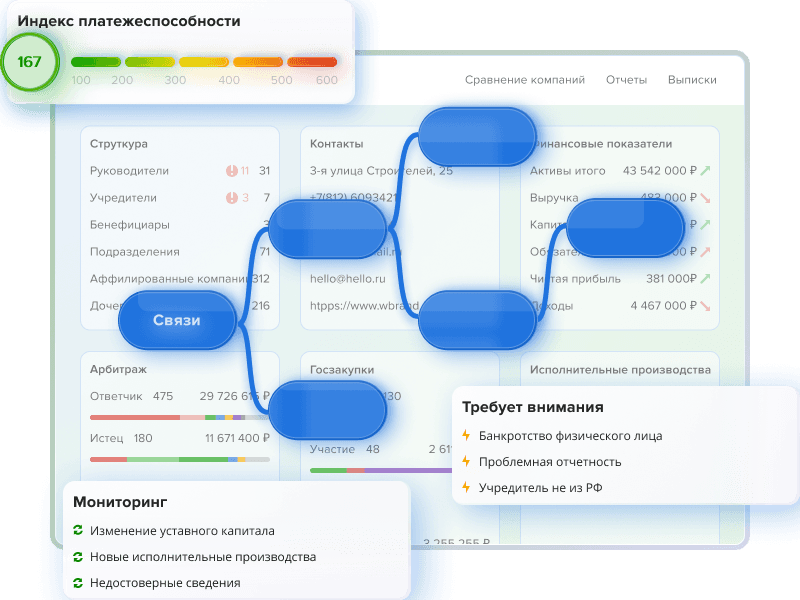
The Portfolio Module is designed for mass screening and monitoring of counterparties and allows to build a systematic approach to risk management. The Module provides daily screening of all companies in the portfolio of counterparties and automatically informs the user about the emergence of factors requiring attention:
  • activities ceased
  • bankruptcy
  • in the process of termination
  • bankruptcy of an individual
  • violators of the law
  • etc.
This allows to abandon the constant manual control of each company and quickly respond to changes that may affect further cooperation.
In addition to monitoring of existing counterparties, the Portfolio Module can be used for initial analysis of companies, for example, when selecting suppliers, participating in procurement, signing or renewing contracts. The User receives aggregated information on the entire portfolio of counterparties and can quickly identify companies with an increased level of risk, focusing on them.
As the volume of data grows and the requirements for checking counterparties increase, a mass approach becomes an integral part of risk management. The use of the Portfolio Module in Globas allows to transform the verification and monitoring of companies into a structured and managed format, reduce the cost of routine operations and increase the transparency of cooperation with counterparties.
Globas

Globas

Portfolio Module

Mass screening of counterparties, daily monitoring, a complete picture of risks and convenient analytics in one solution. Portfolio can screen companies for 250+ risk factors, automatically determine the total risk level of counterparties, graduate companies by risk levels, regularly monitor, screen for a list of triggered factors, visualize analytics for your list.
Topics:
Herald

Screening Candidates and Employees: Tools for Reducing HR Risks with Globas

#
Image: Freepik.com
Screening candidates at the recruitment stage and regular employee monitoring are an integral part of a modern company's risk management system. This approach allows for the timely identification of potential threats, reduction of the likelihood of HR errors, prevention of conflicts of interest, compliance with legal requirements, and maintenance of the company's business reputation.
HR decisions directly affect the stability of the business: hiring errors can lead to financial losses and reputational risks.

1. Obtaining consent to the processing of personal data and primary identification

Check of candidate must begin with a written consent to the processing of personal data (in accordance with 152-FZ Federal Law). This is not only a legal defense of the company, but also a transparent process of interaction with the candidate.
If the applicant refuses to give consent, this is a serious signal for the employer.
Further the personal identification is carried out:
  • verification of passport data and their validity
  • comparison of the resume data with real information (existing and liquidated companies)
  • check for invalid tax ID or signs of forged documents
Possible negative situations:
  • the applicant provides an invalid passport. This may indicate an attempt to hide the identity or provide fictitious data
  • the applicant declares working for a legal entity which was liquidated some time ago. It is not a direct reason for refusal, but it requires clarification of details: when the person worked there, in what status, who can confirm
  • Mentioning in the resume companies not registered in the Unified State Register of Legal Entities. The reason to doubt the veracity of the resume and work experience
How Globas helps: In Globas, you can check the status of the legal entity, the date of liquidation, the history of changes and possible affiliation with the applicant.

2. Wanted list and involvement in extremist activities

The employer must make sure that the applicant is not wanted and is not involved in illegal activities.
The check is carried out via:
  • the Federal Wanted List of the Ministry of Internal Affairs of the Russian Federation
  • search by suspicion of committing crimes
  • search by enforcement proceedings
  • listing in the registers of Rosfinmonitoring (terrorists, extremists, distributors of weapons of mass destruction)
If the applicant is on these lists, it is necessary to issue an official refusal of hiring and notify law enforcement agencies if necessary
  • automatic check of individuals in Rosfinmonitoring lists (exact and possible matches)
  • extracts for the investigated individual from the registers of the Federal Bailiffs Service and the Ministry of Internal Affairs

3. Tax, court debts, fines and state duties

The availability of significant debts is a serious indicator of the financial reliability of the applicant. Special attention should be paid to enforcement proceedings for alimony obligations, tax debts or fines. For example, an applicant with large alimony debts may signal unreliability.
  • extracts on tax, court debts, fines and state duties of an individual
  • check for individual in the Register of Debtors for Alimony Obligations

4. Bankruptcy

According to the 127-FZ Federal Law, citizens declared bankrupt cannot hold managerial positions for:
  • 10 years - in credit institutions
  • 5 years - in insurance and MFOs
  • 3 years - in other commercial organizations
Check is mandatory for management positions.
  • automatic screening of notifications of bankruptcy published in the Unified Bankruptcy Register and Kommersant Newspaper
  • daily data update

5. Participation in legal proceedings - Arbitration Courts and Courts of General Jurisdiction

Check of the judicial history of the applicant is one of the key stages in assessing reliability. It is especially important for employees who will make management decisions, work with finances or represent the interests of the company.
Such an analysis allows to assess the reliability of an individual, identify the judicial risks (for example, the availability of criminal, civil or administrative cases) and prevent potential problems in cooperation, hiring or other interactions. This allows to understand whether the person was a participant in the proceedings as a plaintiff, defendant or third party.
  • to view court cases involving the required person
  • to use filters by case type, region, period, court, status, etc.
  • to view the case file with filed documents to explore the details

6. Self-employment

Despite the popularity of self-employment, the transition of an employee to this status is a risky practice. The Law No. 422-FZ prohibits concluding a civil contract with a person who worked at your company under an employment contract less than two years ago and is now self-employed.
How Globas helps: checking the status of a self-employed person at the time of opening the Person's profile.

7. Conflicts of interest

Conflicts of interest are especially important when making deals. A transaction with a conflict of interest is a transaction with a personal interest, which means increased legal risks and possible damage to the interests of the company.
Examples:
  • the employee makes a decision on the purchase of goods, the exclusive rights to which belong to himself
  • the employee enters into an agreement with a relative registered as an individual entrepreneur
  • the executive leads the company into liquidation in order to create own company and lure clients
  • Links tool to identify direct and indirect affiliations
  • check of intellectual property and participation in the business

8. Sanctions Compliance

When checking applicants, it is important to take into account not only classic legal and financial risks, but also sanctions restrictions.
If it is about hiring to a Russian company, international sanctions regimes may not be directly applied. However, national legislation requires consideration of a number of limitations:
  • lists of foreign agents and links to organizations the activities of which are recognized as undesirable in the territory of the Russian Federation
  • counter-sanction measures established by presidential decrees and decrees of the Government of the Russian Federation
  • financial monitoring requirements within the framework of legislation on combating money laundering and the financing of terrorism
Moreover, many organizations have internal corporate policies that provide for:
  • checking persons in the Register of Politically Exposed Persons
  • internal stop lists to minimize reputational and legal threats
How Globas helps: The Sanctions Compliance allows to screen a candidate for all key lists of sanctions compliance: sanctions, terrorists, extremists, foreign agents, PEP, undesirable organizations.

9. Link analysis

An applicant's affiliation with other companies and individuals can pose serious personnel, legal and reputational risks, especially when it comes to hiring for managerial or financially significant positions.
How Globas helps: The Links tool allows you to build interactive graphs of links between objects, identify both direct, indirect and archival links.

10. Monitoring

The check does not end after hiring.
Regular monitoring of employees is a part of systemic personnel security.
  • identification of new established companies or individual entrepreneurs
  • executive disqualification control
  • monitoring of notifications on bankruptcy
  • checking for the multiple executive, shareholder
Checking applicants while hiring and regular monitoring of employees are not a formality, but a key component of the personnel risk management system. This approach helps prevent conflicts of interest, reduce the likelihood of recruiting errors, protect the company's reputation and comply with legal requirements.
Globas provides a set of tools for in-depth and quick check of persons: from basic identification and verification against negative registries to analysis of links and monitoring of changes.
Globas

Globas

Quick check of a business partner, contractor or applicant from reliable sources

Screening is carried out in accordance with the law. Official sources of information are used. An extensive list of parameters is examined: validity of passport and tax number (INN); judicial and extra-judicial bankruptcy; prohibitions and restrictions on business activities; self-employed status; pledges; tax and judicial debts, fines; legal proceedings - Arbitration Courts and Courts of General Jurisdiction; bringing to subsidiary liability; criminal investigation and much more.

Topics: