The financial condition of any company can be assessed through the analysis of key indicators and ratios. The main goal of such an analysis is to determine the level of solvency and reliability of the counterparty. This helps to build a strategy for interaction with partners and make the right management decision.
The financial statements of companies can seem complicated and intended only for accountants and auditors. In fact, its main indicators can be quickly read and understood even without deep knowledge in accounting. The main thing is to know where to look and how to interpret the figures.
Why the financial statement is necessary
The financial statement is a mirror of business.
It indicates the following:
- how much the company earns
- how the company manages costs effectively
- whether there are debts and how big they are
- whether the company will be able to meet obligations in the future
For partners and counterparties, the financial statement is a source of information about the reliability of the company, its sustainability and prospects.
Main statements
In Russia, there are two main statements:
- Balance Sheet (form 1) shows what the company owns (assets) and at what expense (own or borrowed) these assets are formed.
- Financial Result Statement (form 2) demonstrates how the company earns: revenue, expenses and profit.
Additionally, Cash Flow Statement can be used, but two main forms are sufficient for express analysis.
Where to start a quick analysis
In order not to get confused in dozens of lines, it is necessary to highlight several key indicators:
- Revenue. The main indicator of the scale of the business. Comparing it with last year, the growth indicates development and decline indicates problems.
- Net profit. Shows the final result. Sustained positive returns are a sign of success. Losses are permissible, but it is important to understand their causes and regularity.
- Capital and reserves. This section in the balance sheet shows the size of the company's own funds. If the capital is negative, this is a wake-up call. It means that own funds are "eaten up" by debts of previous years, and the generation of current ones is not enough to reach at least zero.
- Debts (liabilities). It is necessary to pay attention to the ratio of borrowed and own funds. The excessive debt burden increases the risk of insolvency.
- Liquidity. Ratio of short-term assets (money, inventory, receivables) to short-term liabilities. It shows the company's ability to meet the short-term liabilities. If there are fewer assets than debts, the company may begin to experience a shortage of funds.
Three Questions Method
To simplify the analysis, you can ask three basic questions:
1. Is the company making or losing money?
Look at profit.
2. Is the company growing or shrinking?
Compare revenue for several years and the size of assets.
3. Is the company reliable or overloaded with debt?
Assess the balance between own funds and obligations.
Look at profit.
2. Is the company growing or shrinking?
Compare revenue for several years and the size of assets.
3. Is the company reliable or overloaded with debt?
Assess the balance between own funds and obligations.
By answering these questions, you can get an overview of the financial situation of the business.
Additional indicators to pay attention to
- Dynamics: it is not one-time figures that are more important, but a trend. Is there stability in revenue and profit growth?
- Comparison with the market: a company may show growth, but slower than competitors or vice versa.
- Significant movements: sharply enlarged debts or falling profits can often signal trouble.
Financial statements are not only a set of numbers, but a convenient tool for assessing the reliability of partners. If you learn to quickly highlight key indicators, then in 5-10 minutes you can understand the general state of the company and make a more informed decision on cooperation.
Globas capabilities in financial analysis
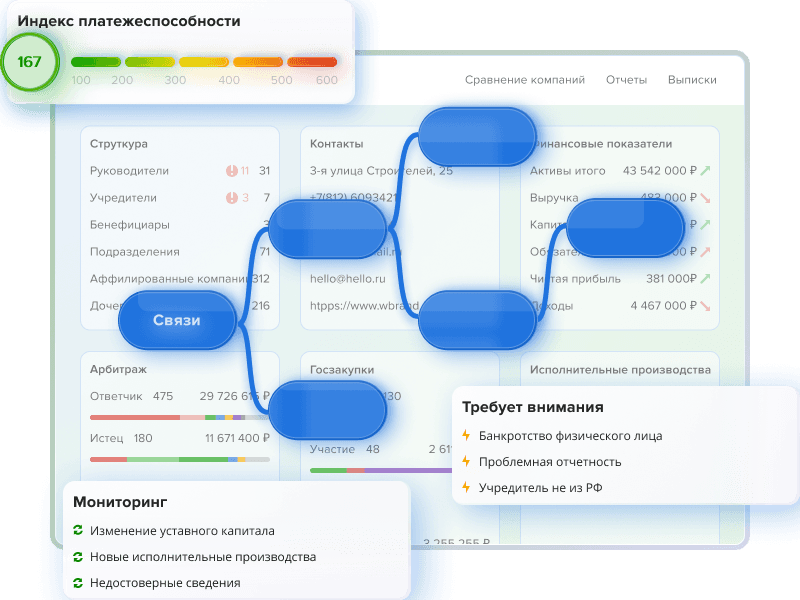
The Information and Analytical System Globas allows you to conduct an in-depth check of the financial condition of a counterparty, identify a temporary loss of solvency and conduct broad analytics on all forms of financial statements.
Globas has everything for a high-quality financial analysis of the counterparty, including all the indicators and ratios described in the express method. In addition, for quick check of a company, the functionality of automatic assessment is available: Analytical Financial Report and Globas Indexes will always inform about the current state of the company.


Globas
Check counterparties in Russia and around the globe
Globas can help checking the reliability of a partner/client assess risks by 350 criteria get compliance, sanctions risks, 115-FZ reports and the report under criteria of the Federal Tax Service monitor changes in the client portfolio obtain official extracts (EGRUL, EGRIP, GIR BFO, RSMP, etc.) analyze the competitive environment and find new customers and suppliers