

Valuing a counterparty without taking into account its industry is a common cause of hidden losses and additional charges from the Federal Tax Service. To promptly detect a partner's pre-bankruptcy status or anomalies in their accounting, conducting a routine audit of publicly available registries is no longer sufficient.
We explain how automated industry analysis helps you compare your company's performance against competitors in just two minutes and protect your business from regulatory risks.
Why do you need industry analysis?
Industry analysis is essential for businesses to minimize risks when selecting partners and to gain a deep understanding of the internal processes of a specific niche.
Professional industry analysis helps commercial departments and top management to:
- Study the market. Objectively assess the capacity of a niche, its development dynamics, and stages of growth or stagnation before launching new directions.
- Assess the competitive environment. See the real distribution of power in the segment, identify leaders and determine their market shares.
- Engage in strategic planning. Make informed management decisions based on solid benchmarks—the standard indicators by which a specific industry operates.
Why is standard verification no longer enough?
Today, counterparty verification is not limited to obtaining an extract from the Unified State Register of Legal Entities and reviewing the arbitration proceedings. Modern compliance includes an assessment of financial status, legal activity, legal proceedings, and signs of bankruptcy.
It is important to remember that analyzing a company without taking into account its industry often leads to erroneous conclusions. Without comparing an organization's performance with industry averages, it is impossible to objectively assess its effectiveness and identify hidden risks.
Example:
The retail chain checks the packaging supplier. According to the standard outline, everything is fine: assets are in the positive, there are no legal proceedings, net profit has increased by 10%. The deal is approved.
But the analysts failed to take into account the context: due to the departure of imported brands, the entire packaging industry grew by an average of 70% over the year. Against the general backdrop, a supplier's 10% growth is not a success, but a systemic regression and market loss. Four months later, due to internal problems, this partner disrupts supplies. Industry compliance would have highlighted this lag at the tender stage.
The problem of manual data collection
To get industry average markers manually, an employee needs to do a huge amount of technical work. You need to find companies yourself by OKVED, download their reports, calculate average values, and clear the database of shell companies and monopolists who distort statistics. This delays the approval of transactions, paralyzes the work of the commercial department and increases the risk of calculation errors. The solution is automation.
Globas tools for industry compliance
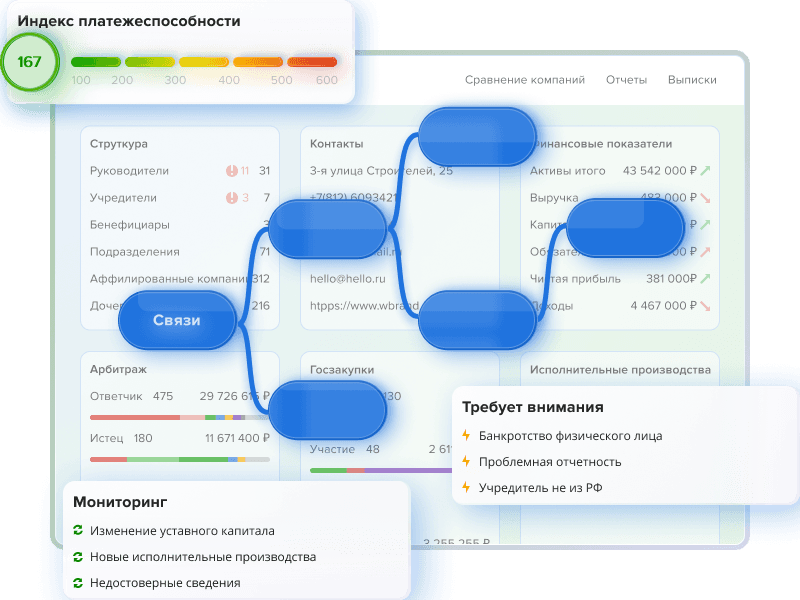
To free businesses from routine tasks and protect against hidden threats, the data matching process in Globas is automated. Tools transform massive amounts of information into clear risk indicators in seconds.
- Competitive environment analysis. The tool allows you to compare the company being studied with its closest competitors, segment leaders, and market leaders. Comparison is made based on financial indicators (revenue, liquidity, financial stability, profitability) and non-financial parameters (number of employees, participation in public procurement, legal and enforcement proceedings). This helps determine the scale of the company, its competitiveness, and identify its strengths and weaknesses compared to other market participants.
- Company's position in the industry. The tool is designed to analyze industry indicators as a whole. It allows you to assess the state of a selected industry using the OKVED code and compare the company's indicators with industry averages. This demonstrates the sustainability of the organization and the compliance of its activities with market conditions.
- Industry index. A visual indicator that reflects the current state of the industry. Thanks to the index, the user can quickly assess general trends and market development dynamics.
How industry analysis helps prevent Federal Tax Service claims
Tax authorities use industry average indicators as a trigger for scheduling audits. If a company's performance deviates from the regional and OKVED averages, this automatically attracts the attention of inspectors.
Identification of tax risks
Comparing an organization's tax burden with industry averages helps identify hidden tax risks and potential claims from the Federal Tax Service. Low counterparty's tax burden poses a risk that the transaction will be recognized as an unjustified tax benefit.
Comparing an organization's tax burden with industry averages helps identify hidden tax risks and potential claims from the Federal Tax Service. Low counterparty's tax burden poses a risk that the transaction will be recognized as an unjustified tax benefit.
Salary level analysis
Comparing salary levels with industry indicators allows us to assess the likelihood of tax audits and other regulatory risks. If the partner pays employees less than the market average, the Federal Tax Service may suspect the use of gray schemes.
Comparing salary levels with industry indicators allows us to assess the likelihood of tax audits and other regulatory risks. If the partner pays employees less than the market average, the Federal Tax Service may suspect the use of gray schemes.
Globas as a risk minimization tool
The simultaneous use of industry and competitive analysis tools allows a company to reach the level of predictive analytics. Globas provides a comprehensive approach that helps you more deeply evaluate your counterparties, predict their stability, and ultimately make more informed management and commercial decisions.


Globas
Automated verification of counterparties
Protect your business from hidden threats, fines from the Federal Tax Service and unreliable partners with the help of Globas. Globas will check counterparties from around the world against 350 risk criteria and generate ready-made compliance reports based on official sources.
Frequently Asked Questions
- How to analyze competitors? Effective analysis requires an assessment of both financial results (revenue, profitability, liquidity) and non-financial parameters (public procurement activity, legal proceedings, staff). In order not to collect this data manually, Globas specialized tools are used: "Competitive Environment Analysis" helps instantly compare a company with segment leaders, while "Company Position in the Industry" and "Industry Index" allow you to quickly assess the dynamics and general trends of the entire market.
- How to check financial stability of the company relative to its market? To do this, it is necessary to compare its key financial ratios (tax burden, salary level) with the industry average values for a specific OKVED code. Significant deviations from market averages often indicate hidden internal problems or inefficiencies in an organization's business model.
- What indicators can lead to a tax audit? The main automatic triggers for the Federal Tax Service are the deviation of the company's tax burden down from the industry average level, as well as the underestimation of the average salary of employees relative to official indicators for this industry in the region.