

We analyze what an internal corporate audit procedure is, what risks need to be taken into account, and how to automate these procedures without disrupting existing business processes.
What is counterparty verification
Counterparty verification is a comprehensive assessment of a legal entity or an individual prior to or during cooperation. Its purpose is to identify circumstances that can lead to financial losses, tax claims, violation of legal requirements or reputational risks.
Today it is not enough to make sure that the company is registered and continues to operate. To make a balanced decision, it is important to assess its financial position, business reputation and the presence of factors that may affect the fulfillment of obligations under the contract.
Regulations for counterparty verification: why they are needed
Employees may use different sources of information, focus on varying risk criteria, or interpret the gathered data differently. To ensure a uniform assessment standard, organizations develop internal corporate verification procedures.
The counterparty verification procedure is an internal document that defines the procedure for conducting an audit, a list of analyzed factors, the sequence of actions of specialists and criteria for making decisions on cooperation.
As a rule, the regulation contains:
- categories of counterparties subject to verification
- list of mandatory sources of information
- risk assessment criteria
- inspection sequence
- requirements for registration of results and their storage
- procedure for making a decision based on the verification results
Stages of the counterparty verification procedure
The specific composition of the verification depends on the internal requirements of the organization, industry and the level of acceptable risk. Most often, the procedure involves the analysis of the following parameters:
- registration data - confirmation of the registration of the company and the relevance of information
- financial condition - assessment of solvency and financial stability
- judicial activity and enforcement proceedings - identification of legal and financial risks
- signs of bankruptcy - analysis of information about possible insolvency
- licenses and permits - verification of the right to carry out licensed activities
- Sanctions restrictions and other risk factors
The more criteria the verification includes, the longer it takes and the higher the likelihood of human error. Therefore, many companies first formalize the process through internal policies and then automate its implementation.
How to automate counterparty verification
Modern specialized platforms allow you to transfer internal verification procedures to digital format. To automate internal corporate procedures, Globas Reports tool is available in Globas.
A company can create its own verification scenario or use ready-made regulatory procedures developed by experts of the Credinform Information Agency. Procedures are based on the requirements of the current legislation, resolutions of the Government of the Russian Federation and recommendations of the Federal Tax Service.
Ready-made Globas Reports:
- Sanctions Compliance screens the counterparty for direct sanctions and the 50 Per Cent Rule, and identifies sanctions risks associated with managers, shareholders, and related parties.
- Criteria of the Federal Tax Service is generated in accordance with the Federal Tax Service guidelines, helping to assess the commercial substance of the counterparty and prove the exercise of due diligence.
- AML/CFT for 115-FZ allows you to conduct verification under the requirements of the Federal Law No. 115-FZ "On Countering the Legalisation of the Proceeds of Crime (Money Laundering) and the Financing of Terrorism".
- Compliance Control helps to identify regulatory non-compliance risks, as well as threats to the counterparty's financial stability and reliability.
- Know Your Customer (KYC) allows you to identify signs of risk of suspicious transactions among customers based on the Decision of the Board of Directors of the Bank of Russia dated 24.06.2022. The results obtained are used as a basis for further assessment and require expert analysis.
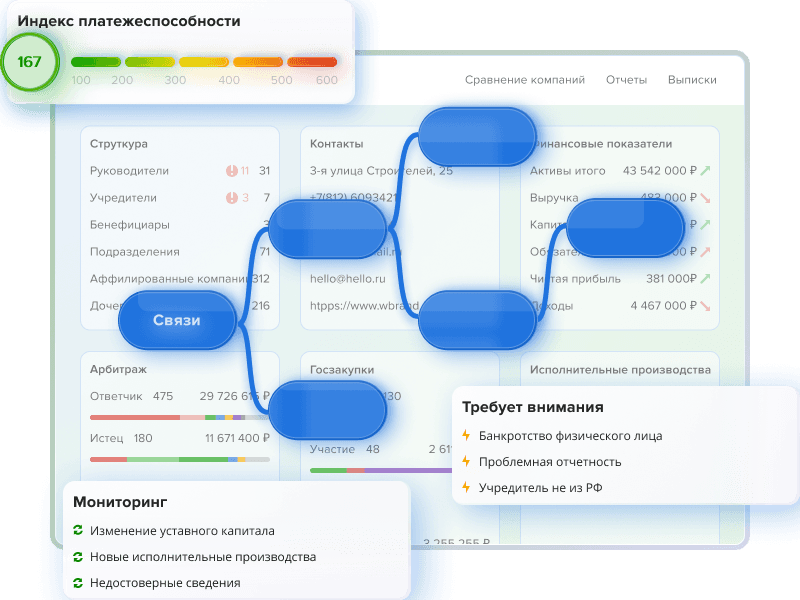
Once configured, simply open the Reports section within the Company Profile, and Globas will automatically run the check based on your specified criteria. If negative factors are detected, the user will see a notification and will be able to review detailed information on each identified risk.
What risks are detected by automated verification
Globas Reports allows you to customize validation scenarios for various business tasks.
Automated verification helps identify:
- signs of bankruptcy and insolvency
- enforcement proceedings
- litigation
- sanctions restrictions
- lack of mandatory licenses and permits
- corruption risks
- criminal law factors
- other circumstances stipulated by the internal regulations of the organization
Over 350 criteria are available to configure verification scenarios, which can be tailored to the counterparty category, internal regulations, and risk management policies. This allows you to create both universal verification procedures and specialized scenarios for certain categories of suppliers, customers, contractors.
What is the role of security experts in automated counterparty verification
Automation greatly simplifies standard verification procedures, but the final decision on cooperation is still made by an expert. Globas helps to quickly gather and analyze information in accordance with the established procedure, while the expert evaluates the findings based on the specifics of each particular situation.
This approach enables to reallocate the experts' time: instead of searching for information and performing routine operations, they can focus on analyzing identified risks, handling non-standard cases, and making informed decisions.


Globas
Free trial for Globas
Automate counterparty verification and test other Globas tools on your tasks
FAQ:
- What is the counterparty verification procedure? The counterparty verification procedure is an internal document that defines the procedure for conducting an audit, a list of analyzed factors, the sequence of actions of specialists and criteria for making decisions on cooperation.
- Is it possible to automate a custom verification procedure? Yes. Modern specialized platforms enable companies to digitize internal regulations and automatically apply them during each counterparty screening. Using the Globas Reports, users can create their own verification scenarios or use ready-made regulatory procedures developed by Credinform experts.
- What risks can automated checks detect? Automated verification enables companies to identify signs of bankruptcy, enforcement proceedings, litigation, sanctions restrictions, a lack of mandatory licenses, corruption and financial crime risks, as well as other threats defined by internal regulations.
- Does automation replace the security professional? No. Automation carries out standard verification procedures in accordance with the specified regulations and helps to quickly identify potential risks. The security professional analyzes the results of the check, evaluates non-standard situations and makes a final decision on cooperation.