Choosing a counterparty is one of the business risks for any organization. Entering into contract with an unreliable organization can threaten financial losses, fines from the tax service, refusal to refund VAT and other troubles. In order to avoid negative consequences, it is necessary to check all companies with which contracts are concluded.
It is necessary to check the entire pool of incoming applications in a short time, identifying unreliable partners at the initial stage of acquaintance with them. Such express check can be provided only if there is a clear procedure for the analysis and a convenient tool for the rapid identification of risk factors.
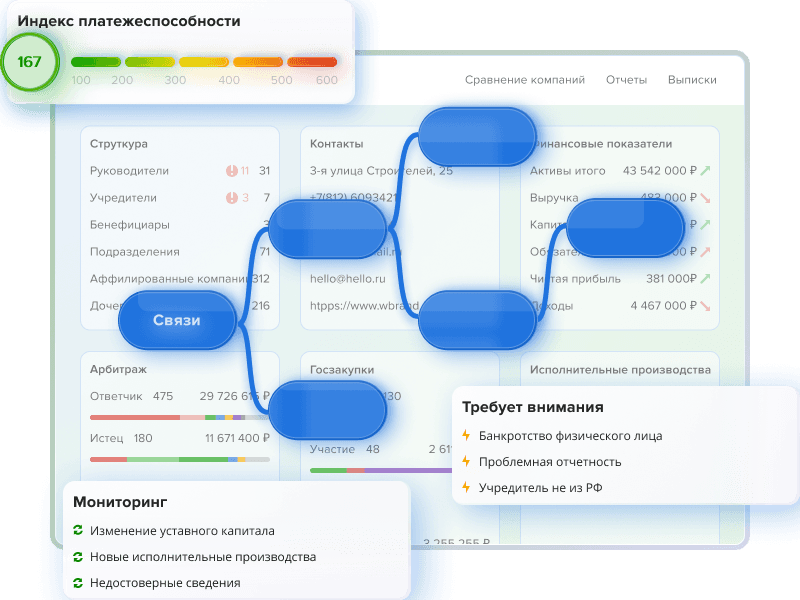
Understanding the tasks of Globas users, daily solving the issues of checking business partners, the experts of the Information Agency Credinform have developed a new structure of the company profile, based on knowledge of sources' features and expert experience.
All the main information about the company is collected in a convenient dashboard, where statistical data, risk factors and infographic elements are presented. End-to-end navigation in blocks, instantly transfers to detailed information on the section of interest. Such data placement allows you to quickly navigate a large amount of information and make decisions about cooperation.

Types of risks when interacting with counterparties
Interacting with business partners, companies may face contractual, tax and reputational risks. The main task of Globas is to help the users to identify such risks quickly.
Tax risks. The Federal Tax Service requires businesses to confirm commercial due diligence when concluding transactions (Letter No. BV-4-7/3060@ of the Federal Tax Service of Russia dated 10.03.2021). If the company does not check the counterparty, thereby not showing commercial due diligence, there is a risk of falling under tax sanctions, and these are additional taxes, refusal of tax deduction, fines and inspections.
Reputational risks. Lost profits, loss of customers and partners due to a negative attitude towards the company. Such risks are dangerous by reducing the level of trust in the organization, which spoils its business reputation.
Сriteria of unreliability
When choosing business partners to conclude a transaction, it is necessary to focus on a set of criteria that determine dubious counterparties. Part of these criteria is determined by the Federal Tax Service (Order of the Federal Tax Service of Russia dated 30.05.2007 N MM-3-06/333@). Let's take a look at the main signs of unreliable companies and ways to identify them using the new functionality of the company profile in Globas.
1. Liquidation, reorganization and bankruptcy
As long as the organization is not excluded from the Unified State Register of Legal Entities, it has the right to carry out business activities. However, cooperation with a counterparty in liquidation, reorganization or bankruptcy may entail negative consequences. Firstly, there are no guarantees that the counterparty will be able to fulfill its obligations before the ceasing operations. Secondly, the court may declare the transaction invalid, and the tax service may accuse of attempting of trying to obtain unjustified tax benefits.
In Globas: if the counterparty is in liquidation, reorganization or bankruptcy, information about this is displayed in the main block of the company profile. Additionally, the liquidation process's initial date, the form of reorganization and the stage of bankruptcy are shown.
2. The discrepancy between the tax burden and the industry average values
A low tax burden is one of the criteria by which the Federal Tax Service can include a company in the plan of on–site tax audits.
In Globas: the actual values of the company's tax burden are compared with the average industry data of the Federal Tax Service. If the figure does not match the indicator for its industry, the deviation is displayed with a color indicator. The "Taxes and Fees" section displays the conclusion, information about paid taxes and fees , as well as arrears. The information will help to estimate the volume of payments made to the budget, and to check whether the company fulfills its tax obligations.
3. Unprofitable activity
In order to minimize contractual risks, it is necessary to check the financial condition and the level of solvency of the counterparty in timely. For example, if a company has sustained losses for several years or expenses exceed revenues, this may indicate inefficient cash management, which, in the future, may lead to bankruptcy.
In Globas: for a quick assessment of the counterparty's solvency, key indicators of financial condition are displayed in the "Financial Indicators" section. Now, based on data on revenue, profit, assets, liabilities, total income and expenses, as well as having studied these indicators in dynamics, we can conclude whether the counterparty is financially stable or it is better to drop the cooperation.
4. Arbitration
The very fact of participation in a large number of trials does not indicate unreliability. The company can collect debts, defending itself from unfair charges or challenging fines. To analyze the information, it is necessary to understand cases and role the counterparty participates in.
In Globas: all arbitration cases are grouped by the party to the case: the defendant, the plaintiff, other. The "Arbitration proceedings" section provides an assessment of the level of the claim load, statistics and the amount of cases for each of the parties, as well as an interactive scale that shows the volume of cases and the result of their consideration.
5. Enforcement proceedings
The analysis of enforcement proceedings is an integral part of a comprehensive check of the counterparty. The check may reveal significant amounts of foreclosure or arrest of property, which affects its further activities and creates bankruptcy risks.
In Globas: the "Enforcement proceedings" section contain all important information for assessing the risk of cooperation: an indicator of the level of outstanding debt, statistics and the amount of writ of execution that remained for collection or have already been closed.
This is not a complete list of criteria necessary for analysis before concluding a transaction. In the updated company profile, you can view in one window the most important information about any company: data from EGRUL/EGRIP, arbitration, bankruptcy, debts, intellectual property, licenses, SRO, checking by sanctions lists and many other important sources.


Globas
Checking counterparties in Russia and worldwide
Globas helps to analyze business partners, removes routine work from specialists conducting checks, and uses only reliable and official sources of information.