Herald

Portfolio Module: Mass Screening and Monitoring of Counterparties in Globas

#
Image: Сгенерировано с помощью ИИ/ Generated with AI
In the counterparties' screening, the trend towards mass analysis of companies is becoming more and more notable. The growth in the number of partners, the complication of regulatory requirements and the increase in the amount of available data form a request for tools that allow assessing risks not pointwise, but immediately across the entire array of counterparties.
Security, compliance and financial control experts are increasingly focused on solutions that allow a large number of companies to be audited in an automated manner and get an overall picture of risks as soon as possible.
Consistent and spot check of companies remains a common method, however, with an increase in the number of counterparties, this approach becomes less effective. The analysis of each company takes time, and when working with dozens, or even hundreds of organizations, the process can be delayed for a long time. In this case, an additional risk arises: in companies that are screened at the beginning of the cycle, new negative factors may appear that can affect the reliability of cooperation.
Even with a small number of counterparties, a one-time check does not give a complete picture of the risks in the long term. Companies are in constant dynamics, and the absence of negative factors at the time of screening does not mean their absence in the future. Therefore, regular monitoring and monitor of changes become a mandatory part of cooperation with counterparties, regardless of the size of the portfolio.
The issue of mass screening is especially acute for organizations with hundreds or thousands of counterparties. Under such conditions, manual screening requires considerable labor. Maintaining a large staff dedicated to checking companies on a daily basis is not always financially efficient. As an alternative, specialized tools are increasingly used to automate processes, reduce the burden on employees and focus on really significant risks.
The Portfolio Module in Globas is one of the solutions.
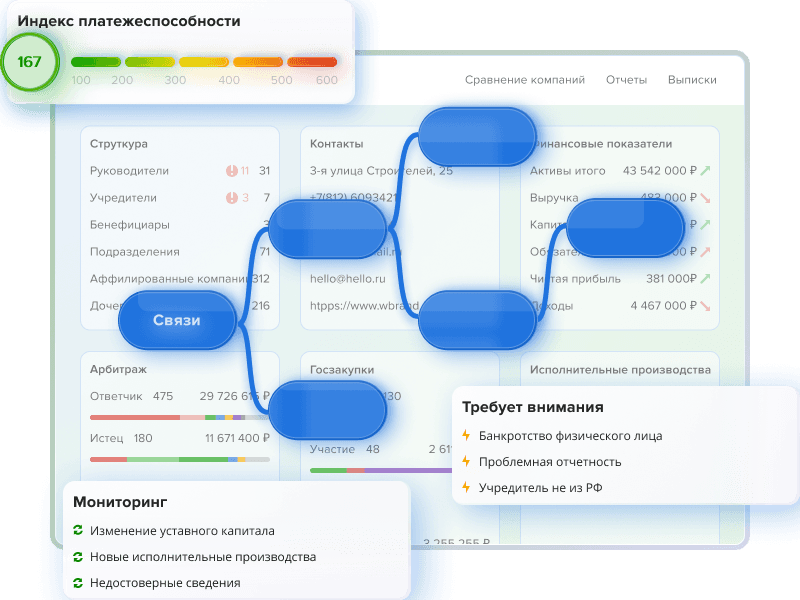
The Portfolio Module is designed for mass screening and monitoring of counterparties and allows to build a systematic approach to risk management. The Module provides daily screening of all companies in the portfolio of counterparties and automatically informs the user about the emergence of factors requiring attention:
  • activities ceased
  • bankruptcy
  • in the process of termination
  • bankruptcy of an individual
  • violators of the law
  • etc.
This allows to abandon the constant manual control of each company and quickly respond to changes that may affect further cooperation.
In addition to monitoring of existing counterparties, the Portfolio Module can be used for initial analysis of companies, for example, when selecting suppliers, participating in procurement, signing or renewing contracts. The User receives aggregated information on the entire portfolio of counterparties and can quickly identify companies with an increased level of risk, focusing on them.
As the volume of data grows and the requirements for checking counterparties increase, a mass approach becomes an integral part of risk management. The use of the Portfolio Module in Globas allows to transform the verification and monitoring of companies into a structured and managed format, reduce the cost of routine operations and increase the transparency of cooperation with counterparties.
Globas

Globas

Portfolio Module

Mass screening of counterparties, daily monitoring, a complete picture of risks and convenient analytics in one solution. Portfolio can screen companies for 250+ risk factors, automatically determine the total risk level of counterparties, graduate companies by risk levels, regularly monitor, screen for a list of triggered factors, visualize analytics for your list.
Topics:
Herald

Business in 2026: an overview of key changes

#
Image: Freepik.com
In 2026, the Russian business will continue to operate in an increasingly complex regulatory environment. Companies will face a higher tax burden, tightening control over labeled products, changes in the rules of tax audits and strengthening the sanctions regime.
Companies will have to adapt to new requirements, create stricter processes for screening counterparties and increase resistance to regulatory, sanctions and operational risks.
We have collected key innovations that come into force in 2026.

Tax reform

  • increase in VAT rate to 22%
From January 1, 2026, the basic VAT rate increases from 20% to 22%.
The reduced rates remain unchanged.
  • reducing the income limit for simplified tax system and patent tax system
The changes affect organizations and individual entrepreneurs using simplified tax system. Income limits, the excess of which leads to the obligation to pay VAT, will be gradually reduced.

YearLimit VAT liability arises
2026RUB 20 millionIf income for 2025 exceeded the limit - from January 1, 2026. If income exceeds the limit during 2026 - from the 1st day of the next month. From the 1st day of the month following the month when income exceeded the established limit
2027RUB 15 millionAnalogous
2028RUB 10 millionAnalogous
Significant changes also affected the patent tax system (PTS).
From January 1, 2026, the maximum income that allows an individual entrepreneur to apply a patent is reduced from the current 60 million RUB to 20 million RUB per year.
If from the beginning of the calendar year the income of the individual entrepreneur exceeds the established limit, the right to apply the patent is automatically lost, and the entrepreneur is obliged to switch to another tax regime from the month following the month of excess.
  • social insurance premiums: cancellation of benefits for SMEs
Since 2026, for most SMEs, the reduced premium rate (15%) has been canceled.
Now SMEs are required to apply general tariffs:
• 30% - within the limit (RUB 2,979,000 per employee);
• 15.1% - over the limit.
The reduced tariffs in 2026 will remain for IT companies and priority industries (the list will be approved by the Government of the Russian Federation):
• IT companies: the rate is 15% within the marginal base and 7.6% above it;
• manufacturing enterprises: a rate of 7.6% over payments of 1.5 minimum wages (as in 2025);
• enterprises of the radio-electronic industry: 0% tariff from 2026.
The benefit is retained only for companies from the list of priority industries (if the corresponding OKVED code is the main one, and the share of income for this type of activity is at least 70%).
  • social insurance premiums for individual entrepreneurs:
- fixed contributions: RUB 57,390
- 1% of additional payments on income over RUB 300,000; limit: RUB 321,818.
Globas provides the opportunity to obtain complete information about the counterparty's taxes and fees, analyze the application of special tax regimes, track changes in the tax burden over the years, and conduct a comprehensive assessment of its financial stability.

Tax registration: a new order

From January 1, 2026, the procedure for confirming the registration of an organization with the tax authorities is changing.
The following will be cancelled:
  • certificate of tax registration;
  • notification of tax registration;
The supporting documents will be as follows:
  • extract from the Unified State Register of Taxpayers (EGRN) - contains information on tax registration (or deregistration)
  • extract from the Unified State Register of Legal Entities (EGRUL) - contains information on registration at the place of location of the organization or its divisions.
All documents issued before January 1, 2026 continue to be valid. If the registration process was initiated, but not completed before January 1, 2026, the tax authority will issue an extract from the EGRN.
In the company's profile in Globas, there is a Registration history section, which allows you to track all changes in registration data. If necessary, you can order an extract on submitted applications to the EGRUL according to forms P11001-P18001.

Tax audits: new rules

Since 2026, the Federal Tax Service will get the expanded powers.
What changes from January 1, 2026:
  • the tax authorities will be able to inspect the premises and seize documents as part of additional measures
  • the reporting periods of the current year can be checked during the field inspection, if they are completed at the decision date
  • any authorized Federal Tax Service will be able to conduct a desk audit
What changes from September 1, 2026:
  • verification materials can be considered by video conference
  • a new procedure for filing objections is introduced: in person, by mail, by telecommunication channels or through the personal account (FTS/Gosuslugi)
  • an upper limit is introduced to reduce the fine under extenuating circumstances - no more than 10 times.
A new section for analyzing the risks of field tax inspections has been developed in Globas.
This tool is based on the Concept of the system for planning field tax inspections developed by the Federal Tax Service and allows:
• check the tax burden, profitability and financial status of the company;
• learn about frequent changes in tax authorities and about reaching the maximum values for special tax regimes;
• identify deviations in wages from industry averages;
• identify the discrepancy between the growth rates of expenses and income;
• identify tax risk in the nature of financial and economic activities;
• receive information about account blocking indicating the reason for the suspension.
If your counterparty is at risk, you may also be subject to field tax inspection.
In Globas you can timely identify such links and avoid the consequences.

Marking and strengthening of control in the "Honest SIGN" system

The reasons for refusal to register goods have been expanded:
  • non-conformity of USAIS/VIS data
  • excess of production volume by more than 5%
New product groups under the label:
  • hygienic products,
  • instant drinks,
  • baby products,
  • a number of building materials.
In Globas you can check the organization for its entry into the register of participants in the turnover of goods subject to mandatory labeling.

Turnover of precious metals and stones

Liability for repeated violations related to the turnover of precious metals and stones has been tightened.
Penalties are as follows:
  • up to RUB 160,000 for individual entrepreneurs,
  • up to RUB 300,000 for the legal entities.
In Globas you can check the organization for its entry into the Register of legal entities and individual entrepreneurs engaged in operations with precious metals and precious stones. The register is maintained by the territorial bodies of the Federal Assay Office in order to carry out targeted control over the compliance of controlled objects with the requirements of the legislation on PMPS and AML/CFT.

Sanctions and counter-sanctions

The government extended the Special Economic Measures (SEM, Counter sanctions). The restrictions on the import and export of certain types of goods have been extended until December 31, 2027.
A wide group of goods falls under the export ban: industrial and medical equipment, electrical equipment, agricultural machinery, as well as a number of high-tech installations, including turbines and reactor equipment.
Increased duties will continue to apply to the import of certain types of food products and drinks. Such categories include meat and fish products, canned goods, pasta, coffee, beer and other goods.
The list of items allowed for parallel imports has been additionally expanded: it includes sanitary and hygienic goods, certain types of medical equipment, as well as equipment used for testing metals.
The Sanctions Compliance module in Globas provides the ability to check Russian and foreign entities, persons, water and air transport. Persons associated with the companies are also checked: beneficiaries, owners, managers, affiliated companies and subsidiaries. The module contains extensive information about the imposed sanctions and restrictions, including the 50 Percent Rule, screening of goods by code or product name, additional sources and deeper analytics on companies, persons and objects that have fallen under restrictions and in various risk registries.
Topics: