
Order a report
Custom-made industry research, company ratings, competitor analysis

Ruble and MICEX index answered in their own way on the Russia’s junk rating made by S&P and Moody’s
In February, after the longstanding fall, the average monthly official ruble exchange rate for the first time since the last summer strengthened by 1% to average monthly January rate, to euro by 2,7%.
In 2014 there was a rapid devaluation of ruble. Following the results of the year the annual average exchange rate (38,6 RUB for 1 USD) exceeded the indicator of 2013 by 21% (31,9 RUB for 1 USD). The ultimate negative trend was registered in November, December 2014 and in January 2015 when the ruble depreciated by 13,3%, 20,7% and 16,8% correspondingly.
The same situation happened concerning euro when the annual average exchange rate of ruble “lost ground” to European currency by 20,3% (42,4 RUB for 1 EUR in 2013, 51 RUB for 1 EUR in 2014).
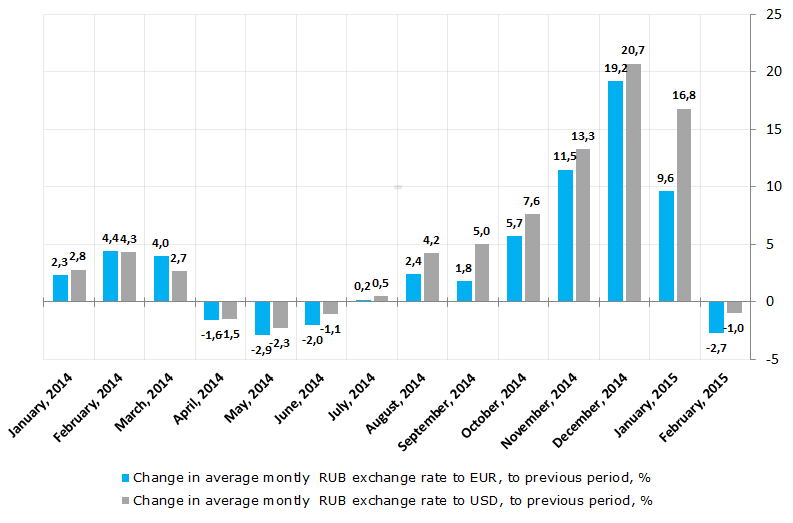
Figure. Change in average monthly official USD and EUR rates to previous period, %
In February 2015 we observe the refraction of the negative trend, when the ruble for the first time since June 2014 has strengthened. It happens against the background of improvement of world oil price environment and certain stabilization of situation in Ukraine after the Minsk Protocol.
Further situation concerning the ruble exchange rate will mostly depend on stability of ascending trend of raw material price. Sanctions of the Western countries and lowering of rated by international rating agencies play a small part.
| Date | Average montly official exchange rate of the Central Bank, RUB for 1 USD | Change to previous period, % | Average official exchange rate of the Central Bank, RUB for 1 EUR | Change to previous period, % |
|---|---|---|---|---|
| January, 2014 | 33,8 | 2,8 | 46,1 | 2,3 |
| February, 2014 | 35,2 | 4,3 | 48,1 | 4,4 |
| March, 2014 | 36,2 | 2,7 | 50,0 | 4,0 |
| April, 2014 | 35,7 | -1,5 | 49,2 | -1,6 |
| May, 2014 | 34,8 | -2,3 | 47,8 | -2,9 |
| June, 2014 | 34,4 | -1,1 | 46,9 | -2,0 |
| July, 2014 | 34,6 | 0,5 | 47,0 | 0,2 |
| August, 2014 | 36,1 | 4,2 | 48,1 | 2,4 |
| September, 2014 | 37,9 | 5,0 | 49,0 | 1,8 |
| October, 2014 | 40,8 | 7,6 | 51,8 | 5,7 |
| November, 2014 | 46,2 | 13,3 | 57,7 | 11,5 |
| December, 2014 | 55,8 | 20,7 | 68,8 | 19,2 |
| January, 2015 | 65,2 | 16,8 | 75,3 | 9,6 |
| February, 2015 | 64,5 | -1,0 | 73,3 | -2,7 |
The good news also comes from the market. Thus in February the MICEX index achieved 1837 points on closing. This figure became the maximum since April 2011. Due to this, displacement of news matters pleases. If earlier the market trembled after any negative decision of such agencies as S&P and Moody’s, which lowered sovereign investment rating of Russia to a junk one in January and February, or after overseas politicians’ statements concerning worsening of country’s investment climate, today such news go unnoticed and just leave the negative mood. This situation can be explained by political partiality of such characteristics, which in some cases doesn’t correspond to real economic climate, national debt rate and dynamics of industrial production.